New Spain, 1668, is the source of Spain’s prosperity through the purging and mining of resources from indigenous land. Resources on the indigenous lands are beginning to thin, but they are generally in a growth period after Hernándo Cortés. It is run by the viceroy, Marquis de Manzera, on behalf of Spain’s royalty. Much of the economy of New Spain at this time was dependent on mining, farming, and ranching. La encomienda was a prominent social factor of New Spain, a corrupt system built on racism, colonization, and class superiority. Immigrants from Europe were legally granted land and indigenous laborers in exchange for their protection from tribes and the teaching of the Catholic faith.
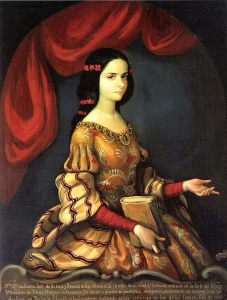
Women were suppressed socially and intellectually through means of fashion, education, and social hierarchy. In high-class society, Guardainfantes were used by women as fashion symbols and protective devices to hide their bodies from men and maintain some control over their lives. They were not traditionally allowed to pursue education. Anything they wanted to do had to be accepted by the male hierarchy. This was the reality of Sor Juana Inés de la Cruz, a leader in women’s rights for education during this time period.
Juana wrote the poem Hombres Necios in 1689 in the same year she released two of her prominent plays, Amor es Laberinto and El Divino Narciso. The poem reflects her existential thoughts on women’s roles in New Spain, educational constraints, and male superiority. I read this poem without translation into English, except for a few words, to preserve Sor Juana’s voice. In the first stanza, she writes:
“Hombres necios que acusáis
a la mujer sin razón,
sin ver que sois la ocasión
de lo mismo que culpáis:”
Hombres Necios translates to “silly men.” She directly addresses men as a whole, pointing out the hypocrisy of them criticizing the role and value of women in society, despite their controlling the degree to which women can grow. Her crude wording is deliberate to give women a voice of power. It continues with:
“si con ansia sin igual
solicitáis su desdén,
¿por qué queréis que obren bien
si las incitáis al mal?”
Why do men expect women to act kindly when treated so poorly? They hold no reservations with how they treat women and what they say to them, but if a woman decides to defend herself, there’s a problem? She continues:
“Combatís su resistencia
y luego, con gravedad,
decís que fue liviandad
lo que hizo la diligencia.”
When a woman resists the orders of a man, he violently aggravated her physically and emotionally. Then, they tell women it’s because they love them, an act of passion. Once again, she continues the theme of hypocrisy amongst men in New Spain, primarily higher-class Spaniards.
“Dan vuestras amantes penas
a sus libertades alas,
y después de hacerlas malas
las queréis hallar muy buenas.”
This stanza focuses on the power men hold over women in society. Despite men treating their lovers with disrespect and control, they expect to find them obedient at every moment. Living day by day in their created freedom, they want to maintain control of their household as well. She ends her poem with three stanzas of questions we must answer for ourselves:
“¿Cuál mayor culpa ha tenido
en una pasión errada:
la que cae de rogada,
o el que ruega de caído?
¿O cuál es más de culpar,
aunque cualquiera mal haga:
la que peca por la paga,
o el que paga por pecar?
Pues, ¿para qué os espantáis
de la culpa que tenéis?
Queredlas cual las hacéis
o hacedlas cual las buscáis.”
These two stanzas display her existential mind to full effect. This web of questions focuses on the cost of emotional turmoil. Who’s more in pain, more at fault, after a failed relationship? The one who leaves after begging for a change, or the one who begs for their lover to stay? The one who begs for a change in pain, or the one who promises to change after nothing is working? Who’s more evil, despite any wrongdoing: the one who sins for their desired outcome, or the one who pays for their sin? She questions the men reading this. Do they feel guilt from her words? She asks what they’re scared of, alluringly suggesting they may be scared of women being equal to men. She closes the stanza with a simple statement: “Make [women] what you’re looking for.” She knows this poem won’t change society overnight, but she also knows the power she holds over men with her words in that moment.
Juana picks apart the gender hierarchy with style, grace, and fluidity, encompassing a pure existential journey through poetry. She blends criticism with questions that have no single answer, as they depend on the reader themselves. She didn’t want to tell men how she wanted them to treat women; she wanted to see if men would change themselves without needing her to spell it out for them. If they’re as intelligent as they claim to be, they’d understand what she is portraying in her words. The poem is fueled by decades of suppression, barrier-breaking, and fighting for a place in a world built to keep her silent.
The power of the poem is that it didn’t just pertain to New Spain in 1689, or the world in 1689, but also to women’s rights movements happening today. That’s the power of Hombres Necios.

Leave a Reply